CLICK HERE FOR THOUSANDS OF FREE BLOGGER TEMPLATES »

Tuesday, April 8, 2008

New York Yankee Legend

Sports
Babe Ruth
1895-1948

Babe Ruth

George Herman Ruth, known to the world as "Babe Ruth," was the first sports superstar. He might have become baseball's greatest left-handed pitcher. Instead, he moved to the outfield and became its greatest hitter. After leading the Boston Red Sox to two World Series victories, he was traded to the New York Yankees following the 1918 season. The Yankees, who had never won a pennant before, became perennial American League and World Series champions. The Red Sox did not win another World Series until 2004.

Ruth was born on February 6, 1895, in Baltimore. His parents had eight children, but only one other, his sister Mamie, survived infancy. While his parents worked in the tavern they owned, Ruth spent much of his time on his own and got into trouble frequently. Unable to control their son's behavior, Ruth's parents placed him in St. Mary's Industrial School at the age of seven. Ruth hated the regimented discipline of the school, but he learned the game of baseball. By the age of 15, he was playing both catcher and pitcher for St Mary's vasity team.

At the age of 19, Ruth was spotted by Jack Dunn, owner of the Baltimore Orioles of the International League, who signed him to his first professional contract. Ruth's parents had given custody of the boy to the Jesuits at the time he enrolled at St. Mary's, where he was supposed to remain until he turned 21. To complete the contract and remove him from the school, Dunn was forced to adopt him. This led to Ruth's being described as Dunn's "baby," which became "Babe," the nickname the stayed with him for the rest of his life.

Ruth spent only five months with the Orioles before he was sold to the Boston Red Sox. During three seasons in Boston, Ruth was primarily a pitcher. In his first World Series, he pitched 29 2/3rds scoreless innings, breaking Christy Mathewson's record and setting a mark that would stand for 43 years. The Red Sox won the World Series that year and again in 1918. In three regular seasons, Ruth had compiled a record of 94 wins and 46 losses, but despite his stellar performance as a pitcher, he was already developing a greater reputation as a hitter. He played some outfield and some first base during the 1918 season. Playing exclusively outfield for the first time in 1919, he set the major league record with 29 home runs, but the Red Sox finished far behind in the pennant race.

Yankee Stadium

Following the 1919 season, Red Sox owner Harry Frazee sold Ruth to the New York Yankees to raise money for his Broadway theatrical productions. The sale price of $125,000 was more than double what any team had paid for any baseball player prior to that time, but it would prove to be one of the worst business decisions in history. Prior to the trade, the Red Sox had won five of the modern, post-1903, World Series. The Yankees had never appeared in one, let alone won one. It took the Red Sox until 2004 to win their sixth World Series. With Ruth, the Yankees won their first pennant in 1921, won another in 1922, and their first World Series in 1923. In 1920, the Yankees became the first team in baseball history to attract a million paying fans to its stadium, the Polo Grounds, which they shared with the New York Giants. When Yankee Stadium was opened in 1923, it became known, with good reason, as "The House that Ruth Built."

After several spectacular years, Ruth had health problems in 1925 and his home run output declined to 25. Some people began to suggest that Babe was past his prime, but Ruth returned to form in 1926 and in 1927 set a single season home run record of 60 that would not be topped until Roger Maris hit 61 in 1961, in a season that was eight games longer.

In 1930, Ruth was earning a salary of $80,000 a year, a spectacular number in that era. A reporter suggested that perhaps he was overpaid, since Herbert Hoover was only getting $75,000 as president of the United States. Ruth is reported to have replied, "Why not? I had a better year than he did." There have been several reported variations of the statement.

In game three of the 1932 World Series against the Chicago Cubs, Babe was batting in the fifth inning. After pitcher Charlie Root took him to a count of two strikes and two balls, he appeared to point to center field and to shout something at Root. He hit the next pitch about 500 feet into the stands behind center field, the longest home run ever hit at Wrigley Field.
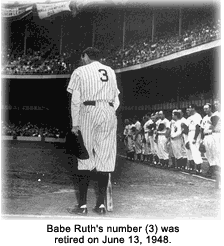
Babe Ruth, Number 3

Ruth wanted to manage a major league team following his career, but the opportunity never arrived. His production began to fall off and he ended his career with the Boston Braves in 1935. At the time of his retirement, his regular season record of 714 home runs was hundreds ahead of his closest competitor and would not be exceeded until Hank Aaron hit his 715th in 1974. His lifetime slugging average of .690 has never been approached. When the Baseball Hall of Fame was inaugurated in 1936, Ruth was one of its first six inductees.

After baseball, Ruth lived a quiet life with his second wife Claire. He had married his first wife, Helen, in 1914 when she was a 17-year-old waitress. The couple had separated by 1926 and the marriage ended tragically when Helen died in an apartment fire in January 1929. Ruth married Claire within three months; they remained together until his death.
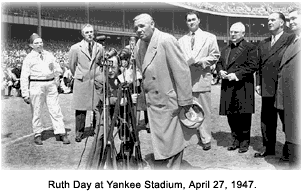
Babe Ruth Day

During the fall of 1946, Ruth was diagnosed with a malignant tumor on his neck. His health began to decline quickly. Baseball fans honored him on April 27, 1947, which was declared Babe Ruth Day for every organized baseball league in the United States. His jersey number 3 was retired at his last appearance at Yankee Stadium on June 13, 1948, which also commemorated the stadium's 25th anniversary. Ruth died on August 16, 1948. More than 100,000 people paid their respects at Yankee Stadium and at his funeral at St. Patrick's Cathedral in New York City.

Alex Rodriguez


Name : Alex Rodriguez
Birth Name : Alexander Emanuel Rodriguez
Date of Birth : 27 July 1975
Place of Birth : New York City, New York, USA
Height : 6' 3''
Nationality : American
Profession : Sportsman (Baseball)
Nicknames : A-Rod, Pay Rod

Signed a 250 million dollar contract to play shortstop for the Texas Rangers in 2000.
Led the American League in Home Runs in 2001 with 53, his first season with Texas, and the most in a season by a shortstop.
In 1998, became the 3rd member of Baseballs 40-40 club (40 home runs and steals in the same season).
1996 American League Batting Champ.
5-time All Star.
Played for the Seattle Mariners from 1994-2000, helping the Mariners to 3 Playoff appearances.
Drafted first overall by the Seattle Mariners in 1993.
Youngest of 3 children.
Moved back with his parents to their native Dominican Republic when Rodríguez was 4, then moved to Miami, Florida 4 years later. There, Alex's father announced he had to go to New York for a short time; he never returned. Rodríguez has said in interviews he can forgive him for abandoning the family, but that he will never forget.
Married longtime girlfriend Cynthia Scurtis in a small ceremony in Dallas, followed by a reception at his 7,500-square-foot mansion. Among the guests were Cal Ripken, Rodríguez's boyhood idol. (2 November 2002).
Was a high school baseball teammate of Doug Mientkiewicz.
Became the youngest (27 years, 249 days) player to hit 300 home runs, breaking the record set by Hall of Famer Jimmie Foxx (27 years, 328 days) [2 April 2003].
Texas Rangers All-Time Slugging Percentage Leader (.615).
Traded by the Texas Rangers to the New York Yankees for Alfonso Soriano and a player to be named later. Prior to the trade, he agreed to switch positions from shortstop to third base. [February 2004]

Jaba Chamberlain


Full Name: Joba Chamberlain Primary Position: P
Height/Weight: 6' 2''/230
Birthdate: 09/23/1985
Birthplace: Lincoln, NE
Bat/Throw: R/R


On August 7, 2007, the Yankees purchased Chamberlain's contract, elevating him to the major leagues for the first time in his career. To make room on their roster, the Yankees designated Miguel Cairo for assignment, and sent down Brian Bruney (coinciding with the activation of Jason Giambi). [1] [2] In his debut, a Yankees victory over the Toronto Blue Jays, Chamberlain struck out the first batter he faced and went on to pitch two scoreless innings, striking out two. The television and stadium radar guns clocked his fastest pitch at 100 and 99 miles per hour, respectively, with his slider consistently registering at 87.

On August 10, 2007, Chamberlain pitched 2 perfect innings against the Cleveland Indians, striking out 1 in the 7th, and the side in the 8th. The following Monday, he retired the Baltimore Orioles 1-2-3 in the 8th inning. Joba struck out 2 while the Yankees won the game, 7-6. It was his Yankee Stadium debut and he was met with chants of "Jo-ba! Jo-ba!" by the home crowd.

For the immediate future, the Yankees plan to use Chamberlain as a bridge from their starting pitching to their closer, Mariano Rivera. In the long run, Joba is expected to break the rotation. Manager Joe Torre has gone as far as stating that he will only bring Chamberlain into a game to start an inning, and newspaper reports that he will get a day rest for each inning.
Chamberlain grew up in Lincoln, Nebraska. At age 3, his parents divorced, and his father Harlan, a counselor at the Nebraska State Penitentiary, took custody of Joba and his older sister Tasha. The family lived in poverty, with Harlan often pawning his possessions to buy things for the children. Joba served as a ballboy for Lincoln Northeast High School's state championship team, and eventually graduated from Northeast. He did not jump straight to college; to help pay the bills, Joba briefly worked for the city of Lincoln's maintenance department.

Chamberlain's father was born on a reservation for the Winnebago American Indian Tribe, but had to leave to be treated for polio. Harlan spent his childhood in hospitals and foster homes and now uses a motor scooter to get around. After retiring from the state penitentiary, he currently works as a substitute teacher and takes tickets at Cornhusker baseball games. Chamberlain still has family living in American Indian reservations.

Joba has a son, Karter, born in 2006.

Chamberlain is one of a few Native American baseball players currently in organized baseball; others include Bobby Madritsch, Kyle Lohse, and Jacoby Ellsbury.

The scouting reports on Chamberlain highlighted his power fastball (95-102), a plus-slider (85-88), a big, slow low-mid 70's curve, and a developing change up. Joba has demonstrated good command of all but his change up, and has the potential to enter the elite starter ranks with three potentially plus pitches.

Chamberlain has quickly risen through the Yankee minor league organization and broke through the major leagues on August 7th, 2007. He struck out and walked two batters in 2.0 IP, and mainly showed off his fastball and slider. His fastball consistently registered from 95-98 and topped at 101 on the TV gun, while his slider consistently registered at 87mph with a very sharp, late bite.

Wednesday, March 26, 2008

History of the stadium


Opened: April 18th, 1923
First Regular Season Game: April 18th, 1923 (4-1 victory against the Boston Red Sox)
Construction Began: May 5th, 1922
Capacity (2006): 57,478
Field Surface: Merion Bluegrass
Cost: $2.5 million ($48 million for 1975 reconstruction)
Dimensions (Original): Dimensions (2006):
Left Field: 280 1/2 feet Left Field: 318 feet
Left Field Power Alley: 460 feet Left Field Power Alley: 399 feet
Center Field: 490 feet Center Field: 408 feet
Right Field Power Alley: 429 feet Right Field Power Alley: 385 feet
Right Field: 295 feet Right Field: 314 feet

Babe Ruth's Bat Babe Ruth was making a name for himself by setting both homerun and pitching records, and he also brought the Boston Red Sox two World Series victories during his 5-year tenure in Beantown. Those World Series championships included the Sox last World Series victory of the 20th century in 1918. The 1919 season, however, saw the Red Sox sitting in 6th place in the American League with a disappointing 66-71 record even as Babe Ruth was smacking 29 homeruns to set a new major league record. The Red Sox were sold after the 1919 season to Harry Frazee, and in December of that year he sold the budding superstar Ruth to the New York Yankees for $125,000 in cash as well as a $350,000 loan intended to fund Frazee's passion for Broadway production. This would become one of the most lopsided deals in sports, and help fuel one of baseball's most bitter rivalries.

Babe Ruth made an immediate impact for the Yankees in his new role as a full-time outfielder, and he would continue to slug homers at a record-setting pace. His slugging did much to improve the Yankees' home game attendance as they became the first professional baseball team to draw more than one million fans in a single season. They did this to the consternation of their current ballpark's tenants, the New York Giants. The Giants were annoyed that the Yankees were outdrawing them in their own park, the Polo Grounds, so they notified the Yankees that they must find a new home field as soon as possible.

On February 6th, 1921 the Yankees announced the purchase of ten acres of property belonging to the estate of famous capitalist and author William Waldorf Astor. The land was situated in the west Bronx directly across the Harlem River from the Yankees' current home in the Manhattan Polo Grounds, and cost the team $675,000. The owners wanted the new field to be a behemoth capable of holding 70,000 screaming fans, and it was already determined that the park would be the first ballpark to be referred to as a "stadium." The exact look of the park, though, had yet to be finalized. An early design had the stadium triple-decked with a roof totally covering the seats so that only passing airplanes could catch a glimpse inside. The grand structure would feature towering embattlements, and would be a marvel of modern architecture. This bold scheme was scaled back, however, and, to the chagrin of the Yankees' owners, the field could actually be seen from the passing elevated train as well as from buildings located across the street. One of the few elements that did survive from the initial draft was a scalloped frieze that would cap the roof of the first triple-decker grandstand in baseball, and it would become a well-known feature of the Stadium.

Monument Park On April 18th, 1923 Yankee Stadium opened its doors to 60,000 baseball fans. Although a higher number of 74,200 was exaggeratedly reported to be at the game it is clear that many thousands of fans had to be turned away after the game was sold out. Those who did have the privilege of seeing the game saw Babe Ruth hit the first homerun in the Stadium; a shot that was described by The New York Times as "the real baptism of Yankee Stadium." Yankee Stadium truly was the "House That Ruth Built," and a few months after the Stadium opened its doors the Yankees won their first World Series title by defeating the rival New York Giants in six games.

The new stadium greatly favored left-handed hitters as the right-field foul pole was a mere 295 feet from home plate. However, Yankee Stadium was far from a hitter's ballpark for the righties with the left-field pole 395 feet from the plate, and left-center a staggering 460 feet away. Left-center field became known as Death Valley for hitters, and the term "Death Valley" would be generically used for the outfield areas of baseball parks where it was difficult to hit a homerun. Monuments to past Yankee greats were placed deep in Death Valley. The first monument honoring manager Miller Huggins was unveiled in 1932, and Lou Gehrig and Babe Ruth followed with plaques in 1941 and 1949, respectively. Another monument was dedicated for Joe DiMaggio in 1999, and other plaques celebrate Yankee greats such as Yogi Berra, Whitey Ford, Lefty Gomez, Roger Maris, Mickey Mantle, Don Mattingly, Phil Rizzuto, and Casey Stengel.

Mark Mulder Mowed Down The Yankees Most Of The Night A great amount of history could been seen at Yankee Stadium even before the Stadium's reconstruction in the mid-70s. Record-breaking homeruns were seen often at the Stadium. Babe Ruth hit his 60th homerun in front of Yankee fans in 1927, and Roger Maris hit his record-breaking 61st homerun on the same field in 1961. In 1939 Lou Gehrig gave an emotional good-bye speech to the hometown crowd on the 4th of July after it was determined he had ALS, or what would later be known as Lou Gehrig's Disease. On May 15th, 1941 Joe DiMaggio hit an RBI single off White Sox pitcher Eddie Smith at the Stadium that would begin his amazing 56-game hitting streak. In 1946 the Yankees became the first team to draw over two million fans in attendance in one season even though they ultimately fell short of making the postseason. Finally, in the 1956 World Series Don Larsen pitched the only perfect game ever in World Series history when he blanked the Brooklyn Dodgers in Game 5. The only time Larsen threw more than two pitches out of the zone was when he reached a third ball against Pee Wee Reese in the first inning. After that the 64,000 fans in attendance got to witness one of the most dominating performances in World Series history. After the Yankee's 50th anniversary in the Stadium in 1973 the Yankees had played in 29 World Series, and they had won 20 titles from those trips.

During the first 50 years of Yankee Stadium the only major changes to the park were the addition of lights in 1946 and a major paint-job in 1966, but in the 70s the park really began to show its age. After years of debate the Yankees signed a 30-year lease with the City of New York in 1972 that called for the Stadium to be completely modernized in time for the 1976 season. After the 1973 season the Yankees moved to Shea Stadium for the next two seasons while a major reconstruction effort took place.

The Stadium was completely demolished following the 1973 season, and a major effort began to make Yankee Stadium the most modern home park in baseball. The steel support columns from the old stadium were done away with and replaced by horizontal support brackets underneath the upper decks that made for better sight lines for the fans. This new design, however, did away with the famous scalloped facade that topped the original Yankee Stadium roof. This problem was resolved with an exact replica of the facade being created to fit atop the new 560-foot-long scoreboard that stretched behind the bleachers in the outfield. The new scoreboard featured the first telescreen in baseball, and could display an amazing nine shades of gray. The revamped Yankee Stadium opened on April 15th, 1976 in a game the Yankees won against Minnesota 11-4. The Yankees made the World Series in their first year at the new stadium, and overall the Yankees would make the World Series 10 times in the new stadium through 2003, winning it 6 times. The Yankees continued success would lead to terms such as "Damn Yankees" and "The Evil Empire," but the favorite term of Yankees fans is the nickname of the Stadium, "The Home of Champions."

Monday, March 24, 2008

27 time world series champions


The New York Yankees have won 27 World Series titles ... more than twice as many as any other team in Major League Baseball history. There was 104 world series that makes about 25% of world series won by the New York yankees. This is the best team in the hostory of baseball.

My Favorite Player


Derek Jeter :

  • Born: 26 June 1974
  • Birthplace: Pequannock, New Jersey
  • Best Known As: Hunky NY Yankee shortstop

Derek Jeter played 15 games with the New York Yankees in 1995; the next year he established himself as the team's regular shortstop and quickly became an all star. The Yankees won the World Series four times in Jeter's first five full years on the job. He was named the team's captain in 2003, becoming the first Yankee captain since Don Mattingly's retirement in 1995. Jeter's good looks have helped make him a favorite with younger fans, and in the early 2000s he was often compared with fellow shortstop prodigies Nomar Garciaparra and Alex Rodriguez. Such was Jeter's reputation that when Rodriguez joined the Yankees in 2004, Rodriguez moved to third base to allow Jeter to remain at shortstop.

Jeter bats right-handed, throws right-handed, and wears uniform number 2... Jeter's father is African-American and his mother is Caucasian; his heritage is reportedly a mix of African, Irish, Indian, and German... With Jeter at shortstop, the Yankees won the World Series in 1996, 1998, 1999 and 2000.

Wednesday, March 19, 2008

My country

Dominican Republic. The most beautiful island in the world. My parents were born in DR. Im from a little town in DR called "Moca", thats were ma father is from and my grandparents have a house in this little house. we always stay at our grandparents house because its like a hotel ova there. Its in a little private neighborhood with a security gate surrounding it. My mother is from el campo( the country). where she's from its very beautiful, it has gardens, farm animals, and little houses surrounding it, covered by large grounds full of grass, with trees all over. There a river near this town and everyone goes and BBQ's there and the kids go swim and have a great! time. This town is in "san. jose de las matas" , and its name is Wahaka. I love my country, and very proud of being dominican.